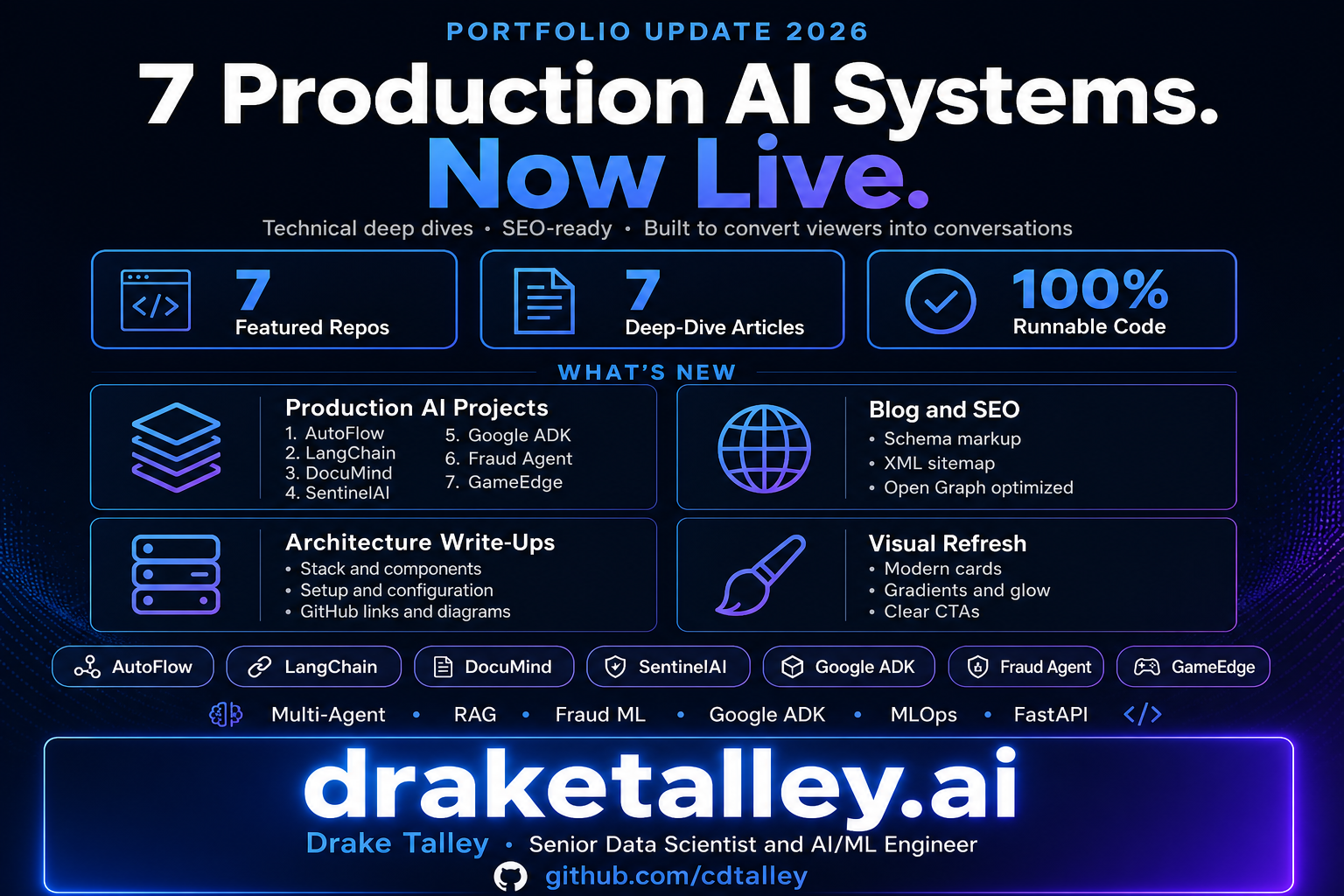
I just shipped the biggest upgrade to my personal site since I launched it. This post explains why I rebuilt draketalley.ai, what went live, and how I plan to use this blog going forward for professional updates, project stories, and lessons from the field.
For a long time, my portfolio did what most portfolios do: it listed projects and hoped the right person clicked through. That works until you realize recruiters, hiring managers, and search engines all want the same thing: context. Not just what you built, but why it matters, how it is structured, and whether you can explain it clearly.
So I rebuilt draketalley.ai with a simple goal: make every serious project discoverable, readable, and runnable. If someone lands on my site from Google, LinkedIn, or a referral, they should leave knowing exactly what kind of engineer I am.
What went live
- Seven production AI systems featured front and center: AutoFlow, LangChain Enterprise Dashboard, DocuMind, SentinelAI, Google ADK Portfolio, Fraud Agent Orchestrator, and GameEdge Intelligence
- A dedicated technical article for every repo, derived from each README: architecture, capabilities, tech stack, and setup steps
- BlogPosting schema, sitemap entries, Open Graph metadata, and canonical URLs on draketalley.ai
- A visual refresh: elevated project cards, mesh gradient backgrounds, and clearer calls to action
- This journal section, for professional updates, launch notes, and stories that do not belong in a README
Why I did it this way
GitHub READMEs are great for developers who already know what they are looking at. They are less great for someone trying to answer: does this person ship production systems, or just demos? Splitting the site into project deep dives plus a professional blog lets me serve both audiences without diluting either one.
The project articles are technical and SEO-targeted. Keywords like multi-agent orchestration, fraud ML with SHAP, local-first RAG, Google ADK agents, and Temporal workflow triage map to real repos with real code. The journal posts are where I share the human side: launches, lessons, career pivots, client patterns, and whatever else is worth writing down while it is fresh.
The through-line across the work
If you scan the seven featured repos, a pattern shows up quickly. I gravitate toward systems that are auditable, local-first where it makes sense, and honest about production gaps. Multi-agent routing with explicit graphs. Policy layers above models. Explainability baked in, not bolted on. FastAPI backends with operator UIs that actually help someone run a demo or review a trace.
That is the story I want hiring teams and collaborators to see. Not a grab bag of tutorials, but a consistent point of view on how applied AI should be built when the stakes are real.
Explore the new project articles
- AutoFlow: multi-agent inquiry automation with LangGraph and Ollama
- LangChain Enterprise Dashboard: enterprise GenAI workbench with hybrid RAG
- DocuMind: local-first RAG with dual Chroma collections and citation grounding
- SentinelAI: real-time fraud scoring with XGBoost, SHAP, and drift monitoring
- Google ADK Portfolio: multi-agent GenAI with tool-grounded résumé facts
- Fraud Agent Orchestrator: policy-as-code triage with Temporal and OPA
- GameEdge Intelligence: sports analytics with sentiment analysis and customer segmentation
What comes next on this blog
I am treating this as a running professional log, not a content marketing calendar. Expect posts when something meaningful happens: a repo ships, a pattern clicks, a deployment lesson hurts, a client conversation reframes how I think about a problem. The goal is consistency over volume, and usefulness over virality.
If you are hiring for senior data science, applied AI, or MLOps, start with the project grid on the homepage, then pick whichever deep dive matches the role you are trying to fill. If you just want to follow the journey, bookmark draketalley.ai/blog and check back when I publish the next update.
Frequently asked questions
- What changed in the draketalley.ai portfolio relaunch?
- Seven production AI systems are featured with dedicated technical articles covering architecture, security, and setup; BlogPosting and FAQ schema, sitemap entries, Open Graph metadata, canonical URLs, a visual refresh, and this journal section for professional updates.
- Who is Drake Talley?
- Drake Talley is a senior data scientist and AI/ML engineer with nine years in data and six in DS/ML/AI across federal fraud pipelines, Vertex AI at scale, enterprise GenAI, and multi-agent orchestration. He builds auditable, local-first applied AI systems documented on draketalley.ai.
- What production AI projects are on the portfolio?
- AutoFlow (LangGraph inquiry automation), LangChain Enterprise Dashboard, DocuMind (local-first RAG), SentinelAI (fraud scoring with SHAP), Google ADK Portfolio, Fraud Agent Orchestrator (OPA + Temporal), and GameEdge Intelligence (sports analytics)—each with a full architecture deep dive on the blog.
- How is the blog organized?
- Project articles are technical and SEO-targeted deep dives derived from each repository README. Journal posts cover professional updates, launches, and career stories that do not belong in a README—both sections share schema markup and canonical URLs on draketalley.ai/blog.